
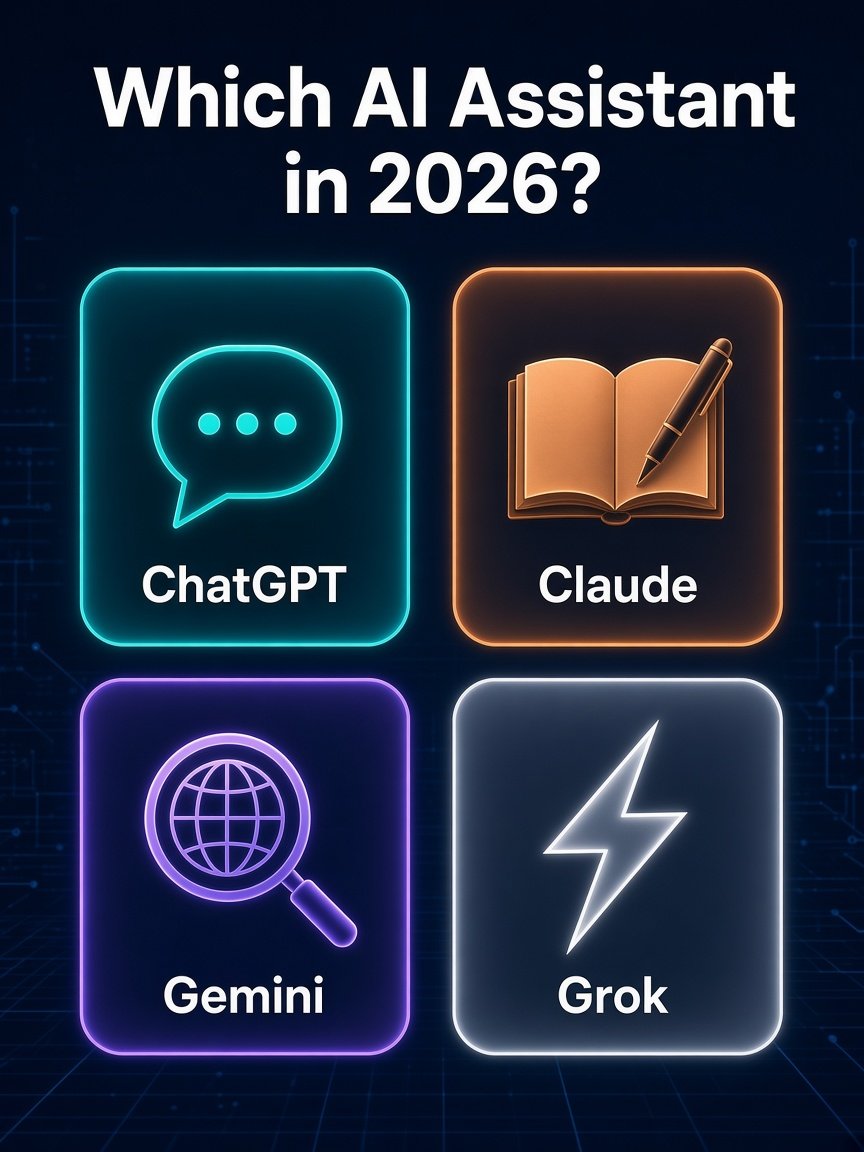
There is no single best AI assistant in 2026. ChatGPT is still the most complete all-rounder. Claude is the stronger pick for long documents and agentic coding. Gemini is the best value if you already work in Google’s apps. Grok is the one to use when you want live data from X, built-in image and video tools, and Cursor in one plan.
Figures below are current as of mid-November 2026. ChatGPT still leads search demand, but the others are growing faster. Trendmule found that U.S. searches in August–October 2026 were up 313% year over year for Claude, 70% for Grok, and 34% for Gemini, while ChatGPT was down 10% but still first. RankControl estimated September 2026 U.S. monthly volumes at 124 million for ChatGPT, 30.4 million for Gemini, 9.14 million for Claude, and 2.24 million for Grok. The names “Gemini” and “Claude” also catch some unrelated searches, so those two figures overstate AI-only demand a little.
ChatGPT vs Claude vs Gemini vs Grok: a quick comparison
Prices are official U.S. list prices, checked in mid-November 2026. App and API context windows are not always the same.
| ChatGPT (OpenAI) | Claude (Anthropic) | Gemini (Google) | Grok (xAI) | |
|---|---|---|---|---|
| Flagship model | GPT-6 Astra | Fable 5.2; Opus 5.5 is the daily driver | Gemini 4 Carbon; Argon is the Pro workhorse | Grok 4.7 |
| Consumer plans | Free; Go $8/mo; Plus $20/mo; Pro $100, $200, or $500/mo | Free; Pro $20/mo ($17/mo billed annually); Max $100/mo; Ultra $200/mo | Free; Plus $4.99/mo; Pro $19.99/mo; Ultra $99.99 or $199.99/mo | Free; Plus $8/mo; Premium $30/mo; Super $100/mo; Ultra $200/mo |
| Best for | All-round work, research, images, Codex | Long documents, writing, Claude Code | Google apps, value, multimodal work | Live X data, Cursor, image and video |
| Context | 256K in Chat on Go/Plus, 400K on Pro; 1.05M on the Astra API | Up to 1M tokens | 1,048,576 tokens, shared by input, thinking, and output | 500K tokens on Grok 4.7 |
| Key features | Web search, Deep Research, images, voice, Codex, ChatGPT Work, Dot (Pro) | Web search; Research, Claude Code, Chrome, and Microsoft 365 on Pro+ | Deep Research (including Free), Gemini Live, Flow video, Antigravity, Chrome auto browse | Web Search plus X Search, Voice, Imagine image/video, Cursor, Grok Bot |
ChatGPT: the default all-rounder
OpenAI’s flagship is GPT-6 Astra. In ChatGPT, “GPT-6 Pro” reasoning is powered by Astra and sits on the Pro plan ($100, $200, or $500 a month). Plus ($20) includes GPT-6 reasoning in Chat and gets Astra in ChatGPT Work and Codex. Free and Go users are on the lighter GPT-5.6 Luna model. On the API, Astra has a 1,050,000-token context window and a knowledge cutoff of 30 April 2026. Standard API pricing is $10 per million input tokens and $50 per million output tokens; prompts with more than 272,000 input tokens cost more.
Consumer plans are Free, Go at $8 a month in the U.S., Plus at $20, and Pro in three usage tiers. Go raises limits on tools, uploads, images, voice, and memory. Plus adds GPT-6 reasoning, expanded Deep Research, projects, scheduled tasks, custom GPTs, and more Codex and Work usage. Pro adds Astra reasoning, longer Work and Codex sessions, faster image creation, and Dot, an always-on agent with its own cloud computer. OpenAI says dots can connect to more than 4,000 apps and are reachable in Slack and Teams. They are rolling out on Pro, Business Premium, and Enterprise in eligible markets. In the Chat app, reasoning context is 256K tokens on Go and Plus and 400K on Pro.
ChatGPT is the safest first purchase if you want one assistant that writes, researches, codes, and generates images. The trade-offs: the best model in Chat is gated behind $100 a month, Pro still has usage limits, and the flagship API is the most expensive of the four. Current plan pages list images, not video.
Claude: long work, writing, and coding
Anthropic’s current lineup is Claude Fable 5.2 for the hardest reasoning and long-horizon agent work, Opus 5.5 as the recommended daily driver, Sonnet 5.5 for speed and everyday quality, and Haiku 5.5 for cheap, high-volume tasks. All four have a 1-million-token context window and a June 2026 knowledge cutoff. API prices per million input / output tokens are $8 / $40 for Fable 5.2, $4 / $20 for Opus 5.5, $2 / $10 for Sonnet 5.5, and from $0.10 / $0.50 for Haiku 5.5.
Plans are Free, Pro at $20 a month or $17 a month billed annually ($200 up front), Max at $100, and Ultra at $200. Free includes web search, file creation, code execution, memory, connectors, Artifacts, voice, Skills, and Claude Design, Docs, and Slides, with tight 5-hour and weekly caps. Pro adds more usage, Claude Code, Research, Projects, scheduled tasks, and Claude in Chrome and Microsoft 365. Fable is not in Pro’s regular limits; you pay for it with usage credits. Max includes about five times Pro usage, Fable for up to half the weekly limit, and $100 a month in API credits. Ultra removes the 5-hour cap for verified accounts, raises weekly usage to about 10 times Pro, and includes $200 in API credits.
Choose Claude for long reports, careful editing, and software work in Claude Code. It has no native image or video generator, so skip it if media is central to your day. Heavy Fable use also gets expensive on Pro, and the 5-hour cap stays in place until Ultra.
Gemini: the Google default, and the cheapest upgrade
Google’s Gemini 4 family is split by depth. Gemini 4 Carbon is the strongest reasoning model, aimed at hard coding, science, and knowledge work. Gemini 4 Argon is the efficient frontier model for most advanced work: faster and cheaper per turn than Carbon, at the same per-token price. Gemini 4 Hydrogen and Flash-Lite sit on the lower plans. Carbon and Argon share a unified 1,048,576-token context window. On the API, both are $2 / $10 per million input / output tokens through 30 November 2026, then $4 / $20 from 1 December. Carbon is not on the free API tier.
App plans are bundled with Google storage. Free includes Flash-Lite, image generation and editing, Deep Research, Gemini Live, Canvas, Skills, limited Google Flow, and 15 GB of storage. Plus is $4.99 a month, with Hydrogen, double the Free usage, video generation, 200 Flow credits, Gemini in Gmail and Vids, and 400 GB. Pro is $19.99, with Argon, four times Free usage, 1,000 Flow credits, Google Antigravity, Gemini in Gmail, Docs, and Vids, Chrome auto browse, YouTube Premium Lite, and 5 TB. Ultra is $99.99 a month for five times Pro usage or $199.99 for 20 times, with the highest access to Carbon. Project Genie is listed on the Ultra 20x plan.
If you already live in Gmail, Docs, and Chrome, Gemini is the most practical choice, and Plus at $4.99 is the lowest paid entry of the four. Deep Research on the free plan is a real advantage. The catch: Carbon is an Ultra feature, and usage still refreshes on 5-hour and weekly limits.
Grok: live X data, media, and Cursor in one plan
xAI’s flagship is Grok 4.7, with a 500,000-token context window and a knowledge cutoff of May 2026. The API is $2 per million input tokens and $6 per million output tokens for prompts under 200,000 tokens, and $4 / $12 once a prompt reaches that threshold. Grok does not know current events unless you turn on its server-side Web Search or X Search tools — and X Search is the feature the others cannot copy.
Consumer access is now The X Subscription, which combines Grok, Grok Bot, Cursor, and X. Plans are Free, Plus at $8 a month, Premium at $30, Super at $100, and Ultra at $200. Usage is a shared weekly pool across Grok and Cursor. Plus includes Chat, Voice, Imagine, Build, API access, and Cursor. Premium, which xAI recommends for new AI users, is four times Plus usage and adds Grok Bot, the latest models, image and video generation, and cloud agents. Super is 15 times Plus usage and can create 1080p, 15-second videos. Ultra is 50 times Plus usage. Third-party models in Cursor, on Premium and above, are billed separately at API list prices.
Grok is the right tool when you care about what is happening on X right now, want image and video in the same app, or would rather pay one bill for Grok and Cursor than subscribe to both. It has the smallest flagship context window of the four, and Premium at $30 costs more than the usual $20 standard tier.
Which one should you choose?
- Everyday writing and research. ChatGPT Plus for the broadest toolkit, or Gemini Pro if your files already live in Google. Gemini’s free plan is enough to test Deep Research before you pay.
- Long documents and careful analysis. Claude, with a 1-million-token window on every current model. Gemini is the alternative if the material is already in Drive.
- Software engineering. Claude Code (Opus 5.5 day to day, Fable 5.2 for harder agent work) is the most focused coding product here. ChatGPT with Codex is the other mature option. Grok Premium bundles Cursor; Gemini Pro and Ultra add Antigravity.
- Google Workspace. Gemini. The Pro plan puts the model in Gmail, Docs, Vids, and Chrome.
- Microsoft 365. Claude Pro and above include Claude for Microsoft 365, Outlook, and Chrome.
- Images and video. ChatGPT, Gemini, and Grok generate images; Claude does not. For video, use Gemini Flow (from Plus up) or Grok Imagine (1080p clips from Super). ChatGPT’s current plan pages list images, not video.
- Live news and social conversations. Grok, because of X Search.
- Always-on agents. ChatGPT’s Dot on Pro is the most fully described always-on agent. Alternatives are Claude’s scheduled tasks, Gemini’s Chrome auto browse and Antigravity, and Grok Bot.
- Tight budget. Gemini Plus at $4.99 is the cheapest paid plan. ChatGPT Go and Grok Plus are $8. All four still have usable free tiers.
- Power use all day. Compare ChatGPT Pro, Claude Max or Ultra, Google AI Ultra, and Grok Super or Ultra in the $100–$200 range. Buy the higher tier for usage and the top model, not the interface.
Many people are better off with two tools than with one $200 plan: Claude or ChatGPT for writing and code, plus Gemini or Grok for Google files, live X context, or video.
FAQ
Which is the best AI assistant in 2026?
There isn’t one winner. ChatGPT is the best default for research, writing, images, and coding in a single app. Claude leads on long documents and agentic coding. Gemini is the best fit inside Google, and Grok is the best fit for live X data and Cursor.
Which AI assistant is the cheapest in 2026?
Google AI Plus at $4.99 a month is the lowest official paid price. ChatGPT Go and Grok Plus are $8. The usual standard tier is about $20 for ChatGPT Plus, Claude Pro, and Gemini AI Pro. Grok Premium is $30, but that also includes Cursor and X features. Claude Pro is the only $20-class plan with a published annual price ($200 a year).
Which is best for coding?
Claude Code and ChatGPT’s Codex are the two most complete first-party coding setups. Choose Grok plus Cursor if you want a local/cloud IDE in the same subscription, or Gemini Antigravity if you are already on Google AI Pro or Ultra. Try two models on your own repo before you commit.
Do you need a $100 or $200 plan?
Only if you hit weekly or 5-hour caps, or you need a top model the mid tier does not include in its regular limits — GPT-6 Astra in ChatGPT Chat, Claude Fable without burning credits, or Gemini 4 Carbon. For most writing and research, Plus, Claude or Gemini Pro, or Grok Premium is enough.
Can you use more than one AI assistant?
Yes, and it is often cheaper than jumping to a $200 tier. Keep a primary assistant for daily work and add a second for a gap: Claude for a long brief, Gemini for a Drive folder, Grok for an X thread, or ChatGPT for image drafts and Deep Research.
Which model has the largest context window?
Claude’s current models and Gemini 4 Carbon and Argon all offer about 1 million tokens. GPT-6 Astra’s API window is 1.05 million, but ChatGPT itself advertises 256K on Go/Plus and 400K on Pro. Grok 4.7 is 500K tokens. A larger window helps with book-length PDFs and whole codebases, not with short everyday prompts.
Conclusion
As of November 2026, the four major assistants share the same product shape — a free tier, an $8–$20 everyday plan, and $100–$200 power tiers — but they are no longer interchangeable. ChatGPT is the most complete general assistant. Claude is the one to open for a long document or a serious coding session. Gemini is the one to open if your work already happens in Google. Grok is the one to open for live X context, native video, and Cursor on a single bill.
Pick the assistant closest to your files and daily tools, then upgrade only when you hit a limit or a missing feature. Recheck official pricing pages before you subscribe; plans and model names are still changing quickly.
Leave a Reply
You must be logged in to post a comment.